Showing posts with label Theology. Show all posts

Tuesday, September 4, 2007

Matins or Members Only?


To my fury Blogspot deleted a pearl-laden post I made about this Guardian article, an intriguing and counterintuitive question about whether the turn to the eucharist in the past century has not come with unforseen problems. The Guardian article asks whether the church wants commitment or numbers, positing that when the typical weekly worship for most Anglican churches was not a eucharist but rather "morning service" (the office of Matins, filled with hymns and psalms but no recitation of the creed and no need to declare oneself as a communicant), the churches were more full than they are now.

I tend to doubt the central implied premise, that people would cheerfully come to church each week if only they weren't required to BELIEVE anything, that people really just want to "do their duty" and avoid theological contestations. I know there are sometimes concerns that eucharists take longer than Matins (which by the by is NOT my experience), and I think the RCC churches filled to the brim on Saturday afternoons show that people seek times for worship more convenient than Sunday mornings, but the idea that participating in a eucharist may be too much commitment for many Christians strikes me as the most dangerous of slippery slopes. In fact, the next ledge down might be that denominating ourselves as "Christians" is too exclusive, in which case we've lost the basics just to add a few more warm bodies.

But this article did challenge me to reflect more; just as the Christian churches have turned to the eucharist, the more "conservative" form of weekly worship, so too have the great monotheistic religions all turned to more fundamentalist emphases, with rather destructive results for the world. What I notice most about this here in London as I hang about with young people is a common reaction of turning against religion overall, of adopting the "coexist" mentality that looks at all religions as doing more harm than good in the 2st century. I don't think Matins over Mass is going to do much to change that.

Friday, August 24, 2007

Mother Teresa's Dark Night of the Soul

A great deal of media coverage seems primed to hit over publication of Mother Teresa's private letters detailing her spiritual dryness over half a century of ministry. I tend to chalk this up to the classical "Dark Night of the Soul" idea, that those in regular and intimate communication with God don't always feel great about it, and that the mystery of suffering hits even the holiest among us. Some surprise is mentioned that Teresa seemed to feel this for so long, with no apparent respite, but I say that the problem with invading someone's private letters is that we don't know what went unrecorded, the single day of ecstasy or consolation so great that she didn't want to tell anyone about it.

The "Atheist Chic" movement is quick to say Teresa "realized" religion was a joke and that's why she spent half a century in spiritual pain. I would answer this with an only slightly less subversive idea; perhaps Teresa realized a great deal of pain over the lack of social justice in the world, specifically how the Christian Church contributes to much of this. Given the state of Christianity today, the days of mystics in ecstasy might well be finished, and perhaps this is a good thing. Running a hospice for AIDS victims is surely noble, but it might well cause one to reflect more on the type of "Christian morality" that influenced people's sexual decisions. Being the most famous nun in the world might well cause some painful doubt about the position of women in the world and in the church.

I don't mean to suggest that Teresa was tormented by a nagging, closeted liberalism, but rather that what we often dismiss as ideology might actually have a deeper spiritual significance that is unavoidable in the end. If one accepts the Natural Law framework that supports a theology of mystics and saintliness, the nagging subconscious realization that how Nature had been formally defined didn't seem to match everyday human reality might well cause anyone spiritual pain. Even a saint.

Tuesday, August 21, 2007

St. Barnabas in Pimlico


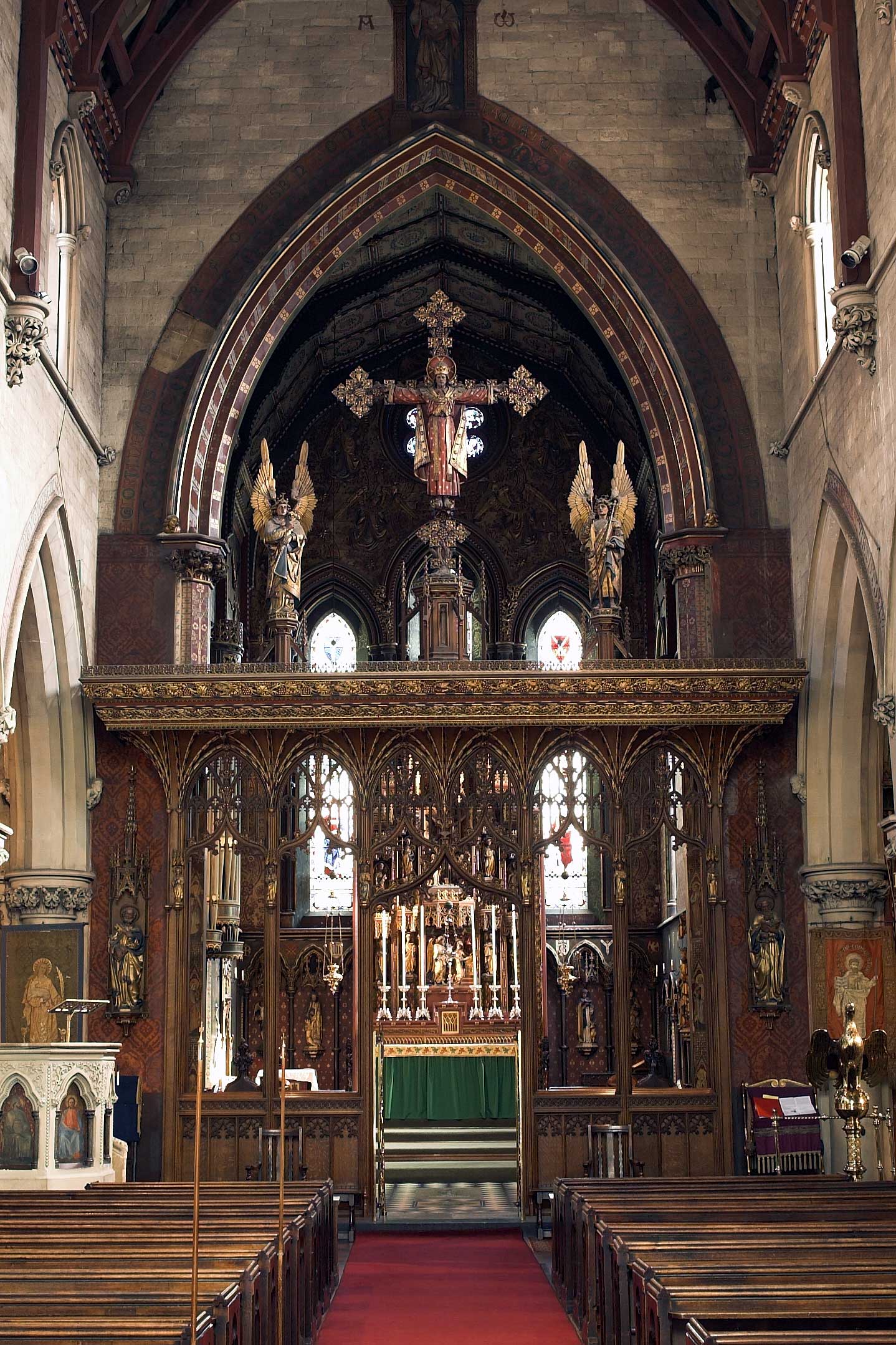
Completely by accident I discovered St. Barnabas in Pimlico, the first church of the Oxford Movement, a place I was quite unable to find on a map when I set out to go there on purpose in July. My feelings were rather mixed; it was "pretty" but with such muddied theology that the sparse simplicity of St. Martin-in-the-Fields is so much more attractive to me, even though I prefer a pure Gothic (Westminster Abbey) or Baroque (St. Paul's) to such sparseness. An Anglican church which looks like a pre-Vatican II Roman Catholic church simply looks odd, and I would tend to question any theology that emphasizes so much the need to separate the laity from the clergy (even if through a fabulous gold reredos!). Interesting to find Stations of the Cross on the walls, theologically unobjectionable to be sure and rather pretty. But alas, there were also the usual warning signs about reservation of the Most Blessed Sacrament, the kind more commonly seen in Italy or Spain, as if actually EATING Holy Communion would constitute a blasphemy. I find myself rather undecided about eucharistic reservation; as an RCC seminarian things like monstrances were completely scandalous to me, and reserving the eucharist 24/7 "for the sick" seems frequently to result in the kinds of eucharistic practices that seem superstitious at best. Yes, I believe in the Real Presence, but the eucharist is Really Present to be Really Eaten, not stared at in a jewelry box or worse yet waved around in a miniature fish bowl. But I have often felt very recollected in front of a tabernacle myself, so I can see how it helps some people pray, and perhaps that is the most important thing.

Tuesday, August 14, 2007

Oxford Warns Evangelical Hall on Misogyny, Homophobia, Academic Standards

I still haven't made it to Oxford yet, but this article certainly gives me even more motivation to do so. Wycliffe Hall, the seminary at Oxford for Anglican ministers of an evangelical persuasion, has been warned to monitor for misogyny, homophobia, and low educational standards. Interesting side note that the average age of an Anglican ordinand out of Oxford is 41; I feel young again!

Sunday, July 15, 2007

Supply-Side Church Market?

Another interesting piece from the Wall Street Journal, commenting on the renaissance of at least some Christian groups in Europe. A bit weak on examples I would say, but it posits a worthy question on whether religiosity in an "open" religious market like the USA is helped by the wide array of options avaliable, suggesting this is occuring in Europe as well where state churches lose their monopoly and are out-competed by "lean and mean" new churches that receive no help from the state.