Showing posts with label Anglicanism. Show all posts

Tuesday, September 4, 2007

Matins or Members Only?


To my fury Blogspot deleted a pearl-laden post I made about this Guardian article, an intriguing and counterintuitive question about whether the turn to the eucharist in the past century has not come with unforseen problems. The Guardian article asks whether the church wants commitment or numbers, positing that when the typical weekly worship for most Anglican churches was not a eucharist but rather "morning service" (the office of Matins, filled with hymns and psalms but no recitation of the creed and no need to declare oneself as a communicant), the churches were more full than they are now.

I tend to doubt the central implied premise, that people would cheerfully come to church each week if only they weren't required to BELIEVE anything, that people really just want to "do their duty" and avoid theological contestations. I know there are sometimes concerns that eucharists take longer than Matins (which by the by is NOT my experience), and I think the RCC churches filled to the brim on Saturday afternoons show that people seek times for worship more convenient than Sunday mornings, but the idea that participating in a eucharist may be too much commitment for many Christians strikes me as the most dangerous of slippery slopes. In fact, the next ledge down might be that denominating ourselves as "Christians" is too exclusive, in which case we've lost the basics just to add a few more warm bodies.

But this article did challenge me to reflect more; just as the Christian churches have turned to the eucharist, the more "conservative" form of weekly worship, so too have the great monotheistic religions all turned to more fundamentalist emphases, with rather destructive results for the world. What I notice most about this here in London as I hang about with young people is a common reaction of turning against religion overall, of adopting the "coexist" mentality that looks at all religions as doing more harm than good in the 2st century. I don't think Matins over Mass is going to do much to change that.

Wednesday, August 29, 2007

Tate Britain Gallery


Spent several hours here last weekend, very delightful, and the best organized gallery I have yet seen, entirely laid out in chronological order from the Middle Ages to 1900. My only complaint is that a few pieces are mounted behind such shiny reflective glass that there was simply no way to get a good view; unless what follows is salt water and tropical fish, there seems to be no need for the aquarium glass! I was especially struck by the Pre-Raphaelite William Holman Hunt's 1952 piece, "Scattered Sheep: Our English Coasts." Taken by many as a comment on Britain's tendency toward isolationism, it was also seen as a rebuke to the clergy of the Church of England for being consumed by internal quarrels during this same time. The sheep certainly do seem bewildered!

Tuesday, August 21, 2007

St. Barnabas in Pimlico


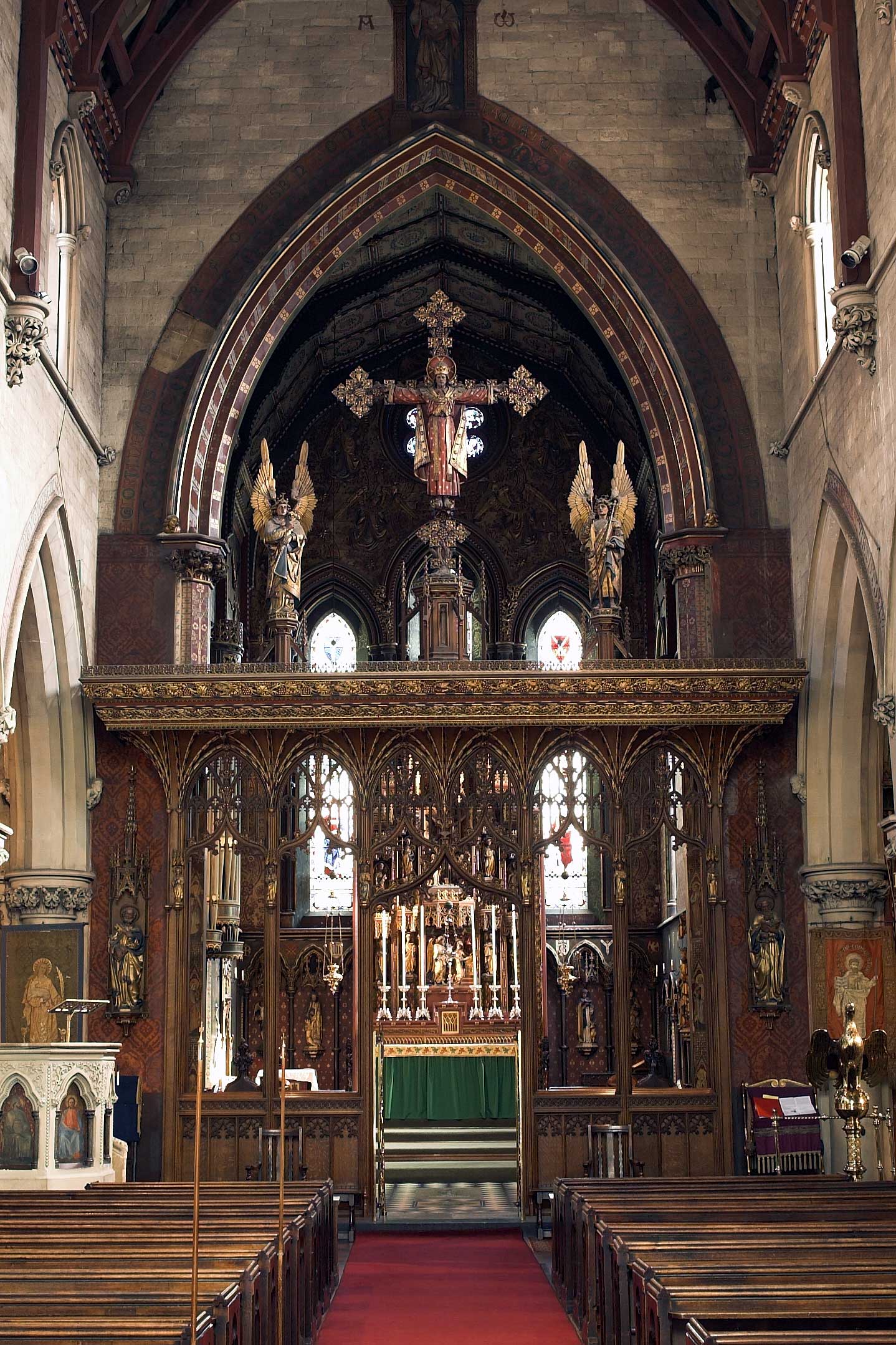
Completely by accident I discovered St. Barnabas in Pimlico, the first church of the Oxford Movement, a place I was quite unable to find on a map when I set out to go there on purpose in July. My feelings were rather mixed; it was "pretty" but with such muddied theology that the sparse simplicity of St. Martin-in-the-Fields is so much more attractive to me, even though I prefer a pure Gothic (Westminster Abbey) or Baroque (St. Paul's) to such sparseness. An Anglican church which looks like a pre-Vatican II Roman Catholic church simply looks odd, and I would tend to question any theology that emphasizes so much the need to separate the laity from the clergy (even if through a fabulous gold reredos!). Interesting to find Stations of the Cross on the walls, theologically unobjectionable to be sure and rather pretty. But alas, there were also the usual warning signs about reservation of the Most Blessed Sacrament, the kind more commonly seen in Italy or Spain, as if actually EATING Holy Communion would constitute a blasphemy. I find myself rather undecided about eucharistic reservation; as an RCC seminarian things like monstrances were completely scandalous to me, and reserving the eucharist 24/7 "for the sick" seems frequently to result in the kinds of eucharistic practices that seem superstitious at best. Yes, I believe in the Real Presence, but the eucharist is Really Present to be Really Eaten, not stared at in a jewelry box or worse yet waved around in a miniature fish bowl. But I have often felt very recollected in front of a tabernacle myself, so I can see how it helps some people pray, and perhaps that is the most important thing.

Tuesday, August 14, 2007

Oxford Warns Evangelical Hall on Misogyny, Homophobia, Academic Standards

I still haven't made it to Oxford yet, but this article certainly gives me even more motivation to do so. Wycliffe Hall, the seminary at Oxford for Anglican ministers of an evangelical persuasion, has been warned to monitor for misogyny, homophobia, and low educational standards. Interesting side note that the average age of an Anglican ordinand out of Oxford is 41; I feel young again!

Thursday, August 9, 2007

New Amy Welborn Blog

Amy Welborn, the Queen of Catholic Blogging and my own inspiration in blogging about a mixture of Important Issues and everyday life in an always interesting way, is in the process of transferring to a new blog. I still check Amy's blog almost every day, and while I sometimes am irritated by her treatment of LGBTQ issues (Amy's dismissive "whatever" comment about the gay couple who write the HBO show Big Love was especially annoying recently), I still love her to pieces. The new title is Charlotte Was Both, an allusion to Charlotte's Web I will leave you to find on your own. Alas, Amy mentions that she chose this title and wanted "no allusive Latin" in the blog title, which made me blush and despair that anyone reads this blog!

Bonus points to any of you familiar with Barchester Towers by Anthony Trollope, from whence the title of my blog comes. A must-read for any Anglicans, especially those of us who enjoy taking ourselves too seriously!

Friday, August 3, 2007

Church House Book Shop


After considerable effort to meet this place's limited operating hours (basically Monday-Friday 9-5, with a precious extra hour on Thursdays), I finally succeeded in gaining entrance. Not quite what I expected--like any religious goods shop I suppose they must cater to plenty of lowest common denominators with lots of jokey books and plastic jimjaws. Perhaps I had puffed up the official book shop of the Church of England a little too much. My biggest surprise was that there were almost as many Roman Catholic items for sale as Anglican, which cheered me to think the my long education was still of much use in the Anglican theological world! I did buy two very interesting books unavailable stateside--The Life and Work of a Priest by the Bishop of Oxford, and Anglican Spiritual Direction by a canon of St. Paul's. Book reviews sure to follow.

Wednesday, August 1, 2007

"The Courage to Steady Our Gaze"

From a collect at St. Paul's this morning, "that with the Virgin Mary we may have the courage to steady our gaze at the poverty of the world." I am consistently finding sources for entire sermons in a single line of a single collect at St. Paul's. Reminds me of something we often discuss at school as part of the mission of social work, that part of the job of the social worker is to "sit with the pain" we find (thank you, Professor Robyn Golden!). Our self-protective instincts have to be overcome for ministry and service really to take place.

Monday, July 30, 2007

Westminster Abbey


Before and after Buckingham Palace on Saturday, I attended three services at Westminster Abbey (Saturday morning eucharist, Sunday morning sung eucharist, and Sunday evensong--held at the scandalous hour of 3:00 p.m.!). I had read in a bookshop that the reform of Edward VI was very hard on the Abbey, and hundreds of vestments were thrown out, with the result that even today the Abbey has fewer vestments than one would expect, coming late to the party that is the High Church revival in the C of E. I saw this was true, everything matched but there were some disagreeable alb & stole combos--wearing just an alb and a stole stikes me as being half dressed, like wearing a necktie over a tee shirt. No sermon on Saturday, but a lovely job on Sunday morning by the Rev'd Deiniol Morgan, Minor Canon, who spoke about how we consistently approach God as if He were consistently in a Bad Mood. Less stellar job Sunday afternoon, too much use of the official parable of the day, the hardships faced by an Iraqi doctor in Baghdad (perhaps I am jaded because this is the official example for many lectures at school). Fascinating array of academic hoods present for evensong--I almost thought I was at Commencement! St. Paul's continues to be be my weekday worship site, but I expect that Westminster will serve on weekends as it is but a 10 minute walk, 20 if I am pokey.

Thursday, July 26, 2007

St. Paul's Cathedral


As I've stated in a few postcards already, I pass by St. Paul's on my way to work each morning. They have an 08:00 eucharist each day, so I have added that to my daily regimen under the "Anglican pilgrimage" component. It was a lovely service, female priest in eucharistic vestments, helpful other clergy, tolerant Brits perfectly willing to model when to stand and sit. Several American college students present as judging from Pepperdine and Arizona State shirts in evidence. It is nice to have regular and even daily access to the eucharist again. One is a bit sad to be outside the Communion here--they have a well-ordered prayer system that seems to include not just the saint of the day (the same everywhere, Anne and Joachim, which the priest introduced well if a bit precipitously in the opening collect) but even a diocese du jour--today was the Sudan. The service itself took place in the north transept, and it will be interesting to see how well attended subsequent eucharists are.

Saturday, July 21, 2007

Harry Potter Parables


Some interesting buzz this weekend on how the Church of England is introducing a new booklet, Mixing it Up with Harry Potter by Owen Smith, as a youth ministry tool for children aged 9-13. The booklet is a twelve session discussion guide. It reminds me of the best traditions in Anglicanism, going back to Augustine of Canterbury, to use the familiar and the comfortable as a tool in evangelization. It also serves as a nice counterpoint to the Roman Catholic and Evangelical officials condemning the Harry Potter books as a paean to witchery. I am mildly cranky that
a 48 page booklet so far seems to cost more than the hardcover edition of the white hot Deathly Hallows book itself, but given the force of the Harry Potter phenomenon I cannot help but think that this will be money well spent for anyone in youth ministry.

Tuesday, July 17, 2007

"The hospital can be a busy, lonely place..."


Great article in the New York Times on the Rev'd Margaret A. Muncie, an Episcopal priest working as a hospital chaplain. Hospital chaplaincy is one of the most popular and most rigorous forms of religious ministry, and it is great to see such good work recognized. As fewer people attend weekly worship services, I am convinced that hospital chaplains will increasingly provide the lion's share of pastoral care for many people in need.

Friday, July 13, 2007

PM to Nix Bish Picks

Is that a catchy title or what? UK Prime Minister Gordon Brown, a member of the (Presbyterian) Church of Scotland and in fact the son of a C of S minister, announced some time ago that he would largely surrender the power to appoint bishops of the Church of England. Reaction seems to be somewhat mixed, with many praising the theological propriety of the move while some worrying that this is a precursor to Disestablishment or simply that Anglicanism will have less of a public role in government.

In the reform of the House of Lords, the 26 bishops currently members so far have retained their seats (the Archbishops of Canterbury and York as well as the Bishops of London, Durham, and Winchester are always Lords, while the remaining 21 bishops are admitted by seniority of consecration). While the Erastianism of government appointment of clergy is certainly to be decried and historically has led to unfortunate theological anomalies (see John Henry Newman on the Jersualem Bishopric), it also served to preserve some measure of lay involvement in clergy appointments that I always thought had some theological value in itself. It will be interesting to see what comes of this, and years from now what would happen if an Anglican PM wished to take back these Erastian powers.