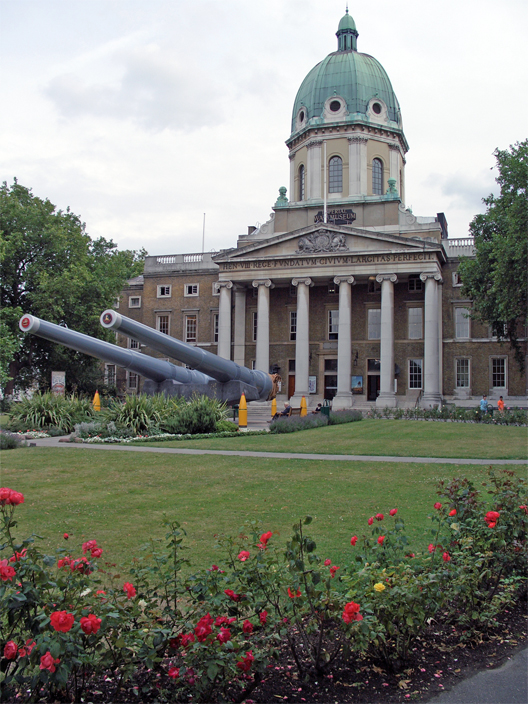
I live right nextdoor to this imposing edifice, immediately to the right of this pic, so given my own military service and my near-obsession with Napoleon and Frederick the Great, it was just a matter of time before I found myself lost here for five solid hours. It was a very powerful experience, with two whole floors devoted to "Crimes Against Humanity" and the Holocaust. I tended to disagree with quite a bit of the museum curators' point of view (I in fact do not think "any of us" could become genocides; I would posit that genocidal societies invariably are societies that devalue and subjugate women; once you subjugate 51%+ of your own population, it's much easier to begin sorting down those to kill; societies where women are not only equal but actually leaders are not ripe to become genocidal anytime soon it seems to me; etc, etc.). Also the snuff film sequence in the middle of the documentary, where we watch one Rwandan after another be slowly butchered, with a final close-up of a 12 year-old boy dying from a severe head gash, seemed to me to have the opposite effect of "sensitizing" us, especially after the documentary rather incredibly segues on from this to sing the praises of Fair Trade Coffee. I love Fair Trade Coffee, I endorse it unreservedly, but after watching the 12 year-old bleed out in close-up I simply wasn't in a very coffee kind of place, and the process of filming these graphic scenes always seems to skirt the edges of morality to me. Not to sound too harsh on the Imperial War Museum; it was in fact a very stirring experience that will remain with me long.
Showing posts with label Moral Theology. Show all posts
Wednesday, August 29, 2007
Imperial War Museum
I live right nextdoor to this imposing edifice, immediately to the right of this pic, so given my own military service and my near-obsession with Napoleon and Frederick the Great, it was just a matter of time before I found myself lost here for five solid hours. It was a very powerful experience, with two whole floors devoted to "Crimes Against Humanity" and the Holocaust. I tended to disagree with quite a bit of the museum curators' point of view (I in fact do not think "any of us" could become genocides; I would posit that genocidal societies invariably are societies that devalue and subjugate women; once you subjugate 51%+ of your own population, it's much easier to begin sorting down those to kill; societies where women are not only equal but actually leaders are not ripe to become genocidal anytime soon it seems to me; etc, etc.). Also the snuff film sequence in the middle of the documentary, where we watch one Rwandan after another be slowly butchered, with a final close-up of a 12 year-old boy dying from a severe head gash, seemed to me to have the opposite effect of "sensitizing" us, especially after the documentary rather incredibly segues on from this to sing the praises of Fair Trade Coffee. I love Fair Trade Coffee, I endorse it unreservedly, but after watching the 12 year-old bleed out in close-up I simply wasn't in a very coffee kind of place, and the process of filming these graphic scenes always seems to skirt the edges of morality to me. Not to sound too harsh on the Imperial War Museum; it was in fact a very stirring experience that will remain with me long.
Friday, August 24, 2007
Mother Teresa's Dark Night of the Soul
A great deal of media coverage seems primed to hit over publication of Mother Teresa's private letters detailing her spiritual dryness over half a century of ministry. I tend to chalk this up to the classical "Dark Night of the Soul" idea, that those in regular and intimate communication with God don't always feel great about it, and that the mystery of suffering hits even the holiest among us. Some surprise is mentioned that Teresa seemed to feel this for so long, with no apparent respite, but I say that the problem with invading someone's private letters is that we don't know what went unrecorded, the single day of ecstasy or consolation so great that she didn't want to tell anyone about it.
The "Atheist Chic" movement is quick to say Teresa "realized" religion was a joke and that's why she spent half a century in spiritual pain. I would answer this with an only slightly less subversive idea; perhaps Teresa realized a great deal of pain over the lack of social justice in the world, specifically how the Christian Church contributes to much of this. Given the state of Christianity today, the days of mystics in ecstasy might well be finished, and perhaps this is a good thing. Running a hospice for AIDS victims is surely noble, but it might well cause one to reflect more on the type of "Christian morality" that influenced people's sexual decisions. Being the most famous nun in the world might well cause some painful doubt about the position of women in the world and in the church.
I don't mean to suggest that Teresa was tormented by a nagging, closeted liberalism, but rather that what we often dismiss as ideology might actually have a deeper spiritual significance that is unavoidable in the end. If one accepts the Natural Law framework that supports a theology of mystics and saintliness, the nagging subconscious realization that how Nature had been formally defined didn't seem to match everyday human reality might well cause anyone spiritual pain. Even a saint.
The "Atheist Chic" movement is quick to say Teresa "realized" religion was a joke and that's why she spent half a century in spiritual pain. I would answer this with an only slightly less subversive idea; perhaps Teresa realized a great deal of pain over the lack of social justice in the world, specifically how the Christian Church contributes to much of this. Given the state of Christianity today, the days of mystics in ecstasy might well be finished, and perhaps this is a good thing. Running a hospice for AIDS victims is surely noble, but it might well cause one to reflect more on the type of "Christian morality" that influenced people's sexual decisions. Being the most famous nun in the world might well cause some painful doubt about the position of women in the world and in the church.
I don't mean to suggest that Teresa was tormented by a nagging, closeted liberalism, but rather that what we often dismiss as ideology might actually have a deeper spiritual significance that is unavoidable in the end. If one accepts the Natural Law framework that supports a theology of mystics and saintliness, the nagging subconscious realization that how Nature had been formally defined didn't seem to match everyday human reality might well cause anyone spiritual pain. Even a saint.
Saturday, July 14, 2007
Should Organ Donors Be Paid?
A great University of Chicago Magazine article asks this very question. I tend to be pretty attached to the con side, based especially on the "commodification of the body" principle (in the abstract) and the prediction that poor donors would not pursue or receive adequate medical care after donating/selling (in the concrete). The pro argument seems to me to be based on a radical utilitarianism that says that some life is always better than no life, so 6500 exploited poor people with missing organs are better than having 6500 people die per year due to inadequate organ donation. Instead I posit that for a Christian, the integrity of the body is a value equal to life, and so it is better to die than to farm human beings for their organs. What do you think?
Subscribe to:
Posts (Atom)